.png)
The accidents that actually send babies to hospital, how to prevent them, and exactly what to do if the worst happens.
Babies do not come with instructions. They are all different, and the mix of hormones, sleep deprivation and sheer responsibility can be overwhelming, especially the first time round. Alongside all of that comes an irrepressible urge to keep this tiny person safe, and a tidal wave of scare stories telling you all the ways you might fail.
Here is the reassuring part. Young babies are fairly well designed and do not get up to much that is genuinely dangerous, so the risk of a serious accident is relatively low. Most babies admitted to hospital are there with a respiratory infection or after an accidental fall, usually while being carried to or from bed. Knowing where the real risks sit, and what to do in the moment, takes most of the fear out of it.
What your baby can do, and when
Accidents tend to arrive hand in hand with new skills, so your home has to keep pace. Somewhere around three months many babies learn to roll, start grabbing at things and post everything they can reach straight into their mouth. By about six months a lot of them can sit up, push and pull, and shuffle or crawl toward whatever has caught their eye. Every new trick opens up a new hazard, which is why safety is less a one-off baby-proofing session and more something you revisit as they grow. The NHS baby and toddler safety pages are a good companion to this guide.
Keeping your newborn safe in the first six months
The single most important habit costs nothing. Never leave your baby unattended on a raised surface or in the bath, not even for a second. Countless babies end up in hospital after wriggling off a sofa, bouncing a chair off a table, or rolling from a changing mat in the half-second a parent reached for a wipe. Change nappies on the floor, keep bouncy chairs and car seats on the ground rather than a worktop, and always strap them into highchairs and buggies.
Follow safe sleep. Babies should sleep on their back, in the feet to foot position, on a firm flat mattress with nothing loose in the cot. Skip duvets and pillows until they are over a year, keep the cot away from radiators, and dress them for a room that sits between 16 and 20 degrees. The Lullaby Trust safer sleep advice is the gold standard and worth reading in full.
Keep soft, small and stringy things well away. Nappy sacks and small objects are a real suffocation risk, because a baby who grabs one does not have the dexterity to pull it off their own face. Never hang drawstring bags on the cot, avoid tie-on cot bumpers, and clip or cut blind cords out of reach. Keep pets out of the sleep space, and do not leave toddlers or older children alone with the baby.
Respect how much heat can hurt. Never drink a hot drink while holding your baby, and never pass one over their head. Watch for microwave hot spots when you warm milk or food by shaking and testing it first, run the bath cold water first and check it with a thermometer, and fit a carbon monoxide alarm while you are at it.
Crawling to walking, a whole new ball game
Once your baby is mobile you genuinely need eyes in the back of your head. They are drawn to anything inappropriate and potentially dangerous, which is how you end up fishing cat litter out of a mouth or, as has genuinely happened on hospital wards, extracting a sprouting pea from a nose. Not every baby crawls first, plenty shuffle on their bottom or go straight to pulling up and climbing, so the safest assumption is that if it can be reached, it will be.
Take the house down another level. Fit stair gates and keep the stairs clear, strap furniture and bookcases to the wall so nothing topples when they climb, and never leave a chair next to a window or worktop that turns into a launch pad. Soft covers on sharp corners and stoppers on doors save a lot of tears.
Batteries, cleaning products and medicines are the big three. Swallowed button batteries, dishwasher tablets and cleaning products cause serious internal injuries, so lock detergents away, choose dishwasher capsules and products containing the bitter-tasting Bitrex, and keep all medicines and batteries out of sight and reach. A childproof cap only slows a determined toddler down, and a handbag left on the floor is an open toy box of hazards.
Keep the kitchen and hot things out of reach. Use a kettle with a short flex pushed to the back of the worktop, cook on the back rings with pan handles turned in, and keep irons, hair straighteners and their trailing flexes well away while they cool. Fireguards, radiator guards and switched-off heated towel rails all earn their place.
Water is one to take seriously. A baby can drown in as little as two centimetres of water. Never leave them alone in the bath even for a moment, empty paddling pools and washing-up bowls the instant you are done, and stay close around ponds and pools. It is also worth getting your car seat and buggy properly fitted for their height and weight, sticking to the age ranges on toys, and giving baby walkers a miss, as they cause far more accidents than they prevent.
A cup of tea is still hot enough to scald a baby 15 minutes after it was made.
It was a little boy scalded by a cup of coffee who inspired me to start First Aid for Life. His mum panicked when she spilt hot black coffee over his arm and the side of his head, and ran outside screaming for help. Had she calmly held the burn under cool running water, his injuries would almost certainly have been less severe, and he might not have needed skin grafts. Always check everywhere the liquid could have reached, too. We once looked after a baby whose arm was treated quickly, but the tea had soaked into his little boot and no one realised until his foot was badly burnt.
In an emergency, what to actually do
Prevention is most of the battle. The rest is knowing the basics for the three situations parents meet most often, so you can act instead of freeze.
If your baby is choking
Anything small enough to fit through a loo roll tube can be a choking hazard, so cut first foods into sticks rather than coins that can seal the airway. Most of the time a baby clears a blockage themselves, and holding them with their head a little lower than their body helps. Stay as calm as you can, because they read panic instantly and it makes everything worse. If they can cough, let them. If they go quiet and cannot breathe, act straight away.
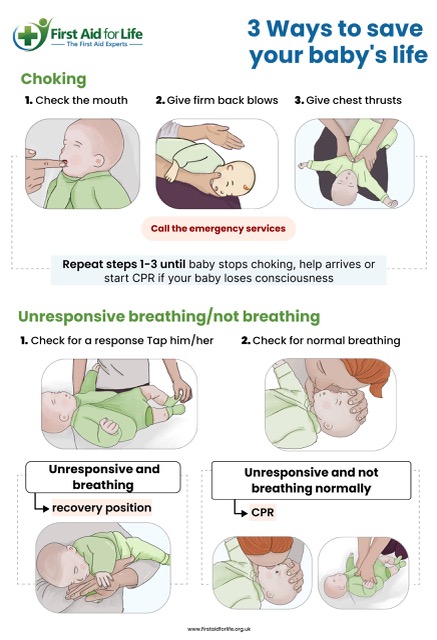
How to help a choking or unresponsive baby. Infographic © First Aid for Life
Here is the sequence, and it is worth practising it in your head now rather than in the moment:
- Stay as calm as you can.
- If they can cough, reposition them and let them try to clear it themselves.
- Look in the mouth and remove anything obvious, but never blindly sweep with a finger, as that can push the blockage further down.
- Lay the baby face down along your forearm, supporting the chin, and give up to five firm back blows between the shoulder blades.
- Check after each blow to see if it has cleared.
- Still choking? Turn them onto their back along your thighs, head low, and give up to five firm chest thrusts with two fingers in the centre of the chest at the nipple line.
- Call 999 or 112 and keep alternating five back blows with five chest thrusts until help arrives.
- If the baby becomes unconscious, start CPR immediately.
If your baby burns or scalds themselves
Burns are frightening, and what you do in the first few minutes changes how much they hurt, scar and damage the skin. Cool the burn under cool running water for a full 20 minutes, and only remove loose clothing over it. Leave anything that has stuck to the skin, or where the skin has blistered, exactly where it is. Reassure your baby and keep them warm and dry while you cool the burn, watching for any signs of shock. Phone an ambulance if the burn is large, broken or blistered, or if they seem shocked, and keep the water running while you wait. Never touch the burn, burst a blister or put any cream on it, and always have a burn checked by a medical professional.
If your baby bangs their head
Babies bump their heads constantly, and it is often more frightening than serious, because the scalp bleeds dramatically out of all proportion to the injury. A severe or repeated blow is a different matter. Call 999 or 112 straight away if your baby loses consciousness even briefly, will not stop crying, seems to have head or neck pain, or is not moving normally. If they did not lose consciousness and are alert and behaving normally, hold a wrapped cold pack on the spot for ten minutes and keep a close eye on them for 24 hours. It is completely fine for them to sleep afterwards, so do not force them to stay awake, just check on them for anything unusual like twitching, or a change in colour or breathing, and do not confuse ordinary sleep with losing consciousness.
The bit worth holding onto
Reading this is a brilliant start, but there is no substitute for practising the skills with your own hands. First Aid for Life runs practical and online First Aid for Babies and Toddlers courses that cover all the common emergencies, so the steps above become something you have done rather than something you once read. You can find them at firstaidforlife.org.uk and onlinefirstaid.com. Most of baby safety is quiet, unglamorous prevention, and calm is the rest.
Related reading: Winter-proofing your baby's skin, the 4-month sleep regression, RSV and your baby this winter, and 5 autumn essentials for newborns.
Written by Emma Hammett, founder of First Aid for Life and onlinefirstaid.com. This article is for general information and is not a substitute for personalised medical advice. If you are worried about your baby, always check with your GP or health visitor, or call 999 in an emergency.
If you’re trying to conceive (TTC), you probably know that there are certain foods and nutrients that become especially important once you’re pregnant. But nutrition plays a vital role even when trying to conceive, much like laying a strong foundation before constructing a house.
Certain nutrients create that foundation by supporting egg and sperm health (yes, nutrition matters for both partners), hormone balance and creating a hospitable environment for a fertilized egg to implant. In fact, studies show that certain nutrients can help increase fertility and improve success rates for both natural conception and fertility treatments.
In other words, nutrition is a key player in the TTC journey, but getting the right nutrients in the right quantities can be tricky. That’s where supplements come in. Just as you’d take a multivitamin to fill in nutritional gaps for optimal health, fertility supplements can give you that extra nutrient boost.
Choosing supplements for your fertility journey
When choosing a supplement to support your fertility journey, look for science-backed, high-quality ingredients. Our editors are careful to select and partner with brands that use ingredients that have been clinically studied to support fertility. Eu Natural® (pronounced you) covers all those bases and more. We love knowing that Eu Natural® products contain zero artificial additives, binders, or fillers and are lab-tested to ensure purity and potency.

When choosing a supplement to support your fertility journey, look for science-backed, high-quality ingredients. Our editors are careful to select and partner with brands that use ingredients that have been clinically studied to support fertility. Eu Natural® (pronounced you) covers all those bases and more. We love knowing that Eu Natural® products contain zero artificial additives, binders, or fillers and are lab-tested to ensure purity and potency.
.webp)
About Emma Hammett R.G.N – Emma is a qualified nurse and award-winning first aid trainer with over 20 years healthcare and teaching experience. Emma is widely recognised as an authority on first aid matters and regularly writes for online and print publications and features in media. Emma is first aid expert for the British Dental Journal, British Journal of School Nursing, Nursing Times, Mail, Evening Standard, Hippocratic Post, Huffington Post and frequently called upon as a TV spokesperson on Sky News, BBC news and Morning Live, ITV News, Channel 4 News, Channel 5 News, London Live, the One Show, Victoria Derbyshire and many more. Emma regularly joined Eamonn Holmes and Mike Graham on their radio shows at Talk Radio and features on many Podcasts.