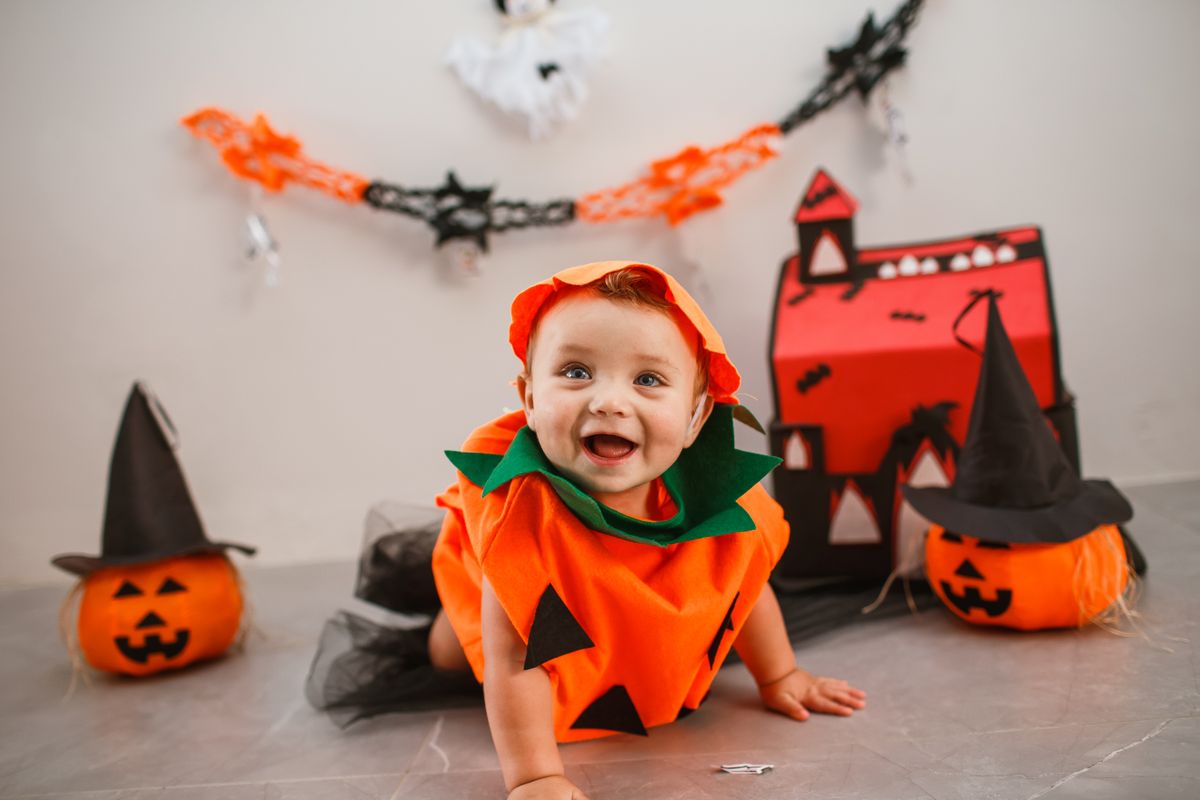
Your baby has no idea what Halloween is. They don't know about pumpkins, they can't eat the sweets and they will almost certainly be asleep before the first knock at the door. Which, when you think about it, makes this the easiest Halloween you will ever do.
A first Halloween doesn't need a theme, a party or a costume that took three evenings and a glue gun. It needs a comfy outfit, a few nice photos and a plan for the doorbell. Here's the gentle version, with the safety bits from NHS and Lullaby Trust guidance, so you can stop worrying and enjoy the pumpkin.
Pick a costume that's basically pyjamas
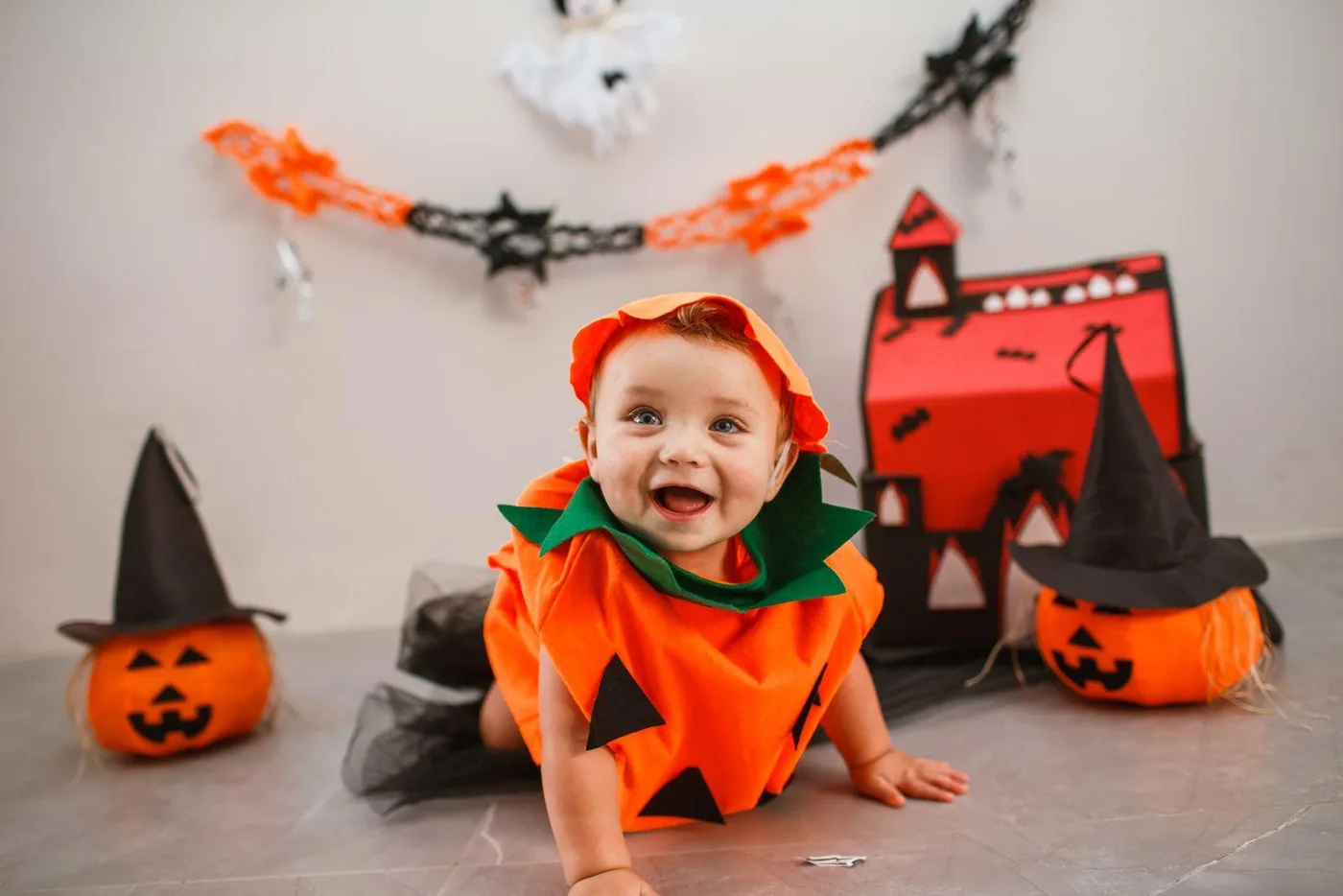
Soft, simple and easy to get off. The best baby costumes are the ones that feel like normal clothes: a onesie with ears, an orange babygrow, a knitted pumpkin hat for the photos. Comfy baby, smug parent, and a nappy change that doesn't need an engineering degree.
Check for bits that come off. The NHS advice on baby and toddler safety is to keep small objects, such as buttons, coins and small toy parts, out of your baby's reach. On a costume, that means pompoms, sequins, plastic eyes and anything else a determined baby could pull off and put in their mouth. If it wiggles when you tug it, snip it off or pick a different outfit.
Watch the layers. Costumes are often fleecy and go over the top of clothes, so it's easy for a baby to get too warm. The Lullaby Trust's cold weather guidance says to check your baby's temperature by feeling their chest or the back of their neck. If they're sweaty or clammy, they're too hot, so take a layer off. Hands and feet will always feel cold, so don't go by those.
Hats off indoors. The Lullaby Trust also says to remove hats and hoods when your baby is indoors or in the car, so they don't get too hot. Good news for the pumpkin hat: it only has to survive the photos. There's more on getting the layers right in our guide to dressing a newborn for autumn.
Take the costume off before any sleep
Babies don't care that it's a special occasion. They will nap in the middle of the photoshoot, the sibling's party and the walk round the block. When they do, the costume comes off.
The Lullaby Trust says that when your baby is sleeping indoors, you should remove any outdoor clothes and hats, and keep the sleep space clear of items such as toys. So the pumpkin hat goes on the side, the themed soft toy stays out of the cot, and your baby goes down in a normal sleepsuit or sleeping bag, on their back, in a clear cot. The recommended room temperature for a baby's sleep space is 16 to 20°C. Our safe sleep guide covers the rest.
Your baby doesn't need a perfect Halloween. They need a comfy outfit, a warm lap and someone guarding the doorbell at nap time.
Pumpkins: carve it, light it, keep it out of reach
Carve during a nap. Sharp knives, slippery hands and a baby trying to grab the lot is nobody's idea of a relaxing evening. Do the carving while they sleep, then let them "help" afterwards by staring at it with deep suspicion. A whole, uncarved pumpkin makes a surprisingly good sensory toy for a sitting baby: cold, bumpy and too big to put in their mouth. Stay close, obviously.
Battery tealights are your friend. A flameless LED light gives the same glow without a real flame at crawling height. If you do use matches, the NHS says to keep matches and lighters out of reach of children. It also says to fit smoke alarms on every level of your home and test them at least every month, so consider Halloween your annual reminder to press the button.
Mind the hot chocolate. If there's a mug of something warm doing the rounds, the NHS advice is to put a hot drink down well out of reach before you hold your baby. It points out that a hot drink can still scald 15 minutes after it was made, which is roughly how long it takes to find the camera.
The doorbell at nap time
Trick-or-treaters tend to arrive right around bath and bedtime, and nothing wakes a baby faster than a cheerful group of skeletons with a knocker. A few options:
- Put up a sign. Something like "Baby asleep. Please don't knock. Sweets in the bowl, take two." Most people are lovely about it.
- Leave the bowl outside. Fewer knocks, and a fair test of your street's honesty.
- Opt out. Plenty of households leave the porch light off and the pumpkin unlit to show they're not taking part this year. Totally fine.
If you're also juggling visiting family who want to see the costume, our kind house rules for newborn visitors work just as well in October.
The sweets they can't have (yet)
This bit is easy if your baby isn't on solids: they get milk, you get the chocolate. If they've started weaning, the NHS food and drinks to avoid page is worth a quick look before the party:
- Choking hazards. Boiled sweets, marshmallows, popcorn, jelly cubes and chewing gum are all listed as choking hazards for babies and young children.
- Sugary snacks. The NHS says these can cause tooth decay and should be avoided.
- Honey. Should be completely avoided until your baby is 12 months old, which rules out the honey-glazed anything.
- Whole nuts. Should be crushed or flaked for children under 5.
If your baby is already on solids, a soft-cooked finger of roasted pumpkin or squash makes a very on-theme plate. And if older siblings come home with a bag of sweets, keep the haul (and the wrappers) up high, away from the crawler. It's worth knowing how to help a choking baby anyway, and our weaning guide has the rest.
Going out, or not
The clocks go back on Sunday 25 October, so by Halloween it's properly dark by teatime. A short pram walk to see the neighbours' decorations is lovely: wrap them up, add something reflective to the pram, and when you get home take the outdoor layers off and check their chest or neck again. If you have a toddler in tow too, there are more ideas in our toddler-friendly Halloween guide.
Or stay in. Pumpkin on the windowsill, baby in a cosy sleepsuit, door firmly shut. That still counts.
Make it a tradition, not a production
Same pumpkin, same spot, every year. Take one photo of your baby next to their pumpkin, then do the same next year and the year after. In a few years the baby will be bigger than the pumpkin, and that row of photos will be worth more than any costume.
Write the date and the outfit in the baby book or a note on your phone. That's it. You've done a first Halloween, and nobody needed a glue gun.
This article is general information based on NHS and Lullaby Trust guidance, not medical advice. If you're worried about your baby, trust your instincts: call NHS 111, speak to your GP or health visitor, or call 999 in an emergency.
If you’re trying to conceive (TTC), you probably know that there are certain foods and nutrients that become especially important once you’re pregnant. But nutrition plays a vital role even when trying to conceive, much like laying a strong foundation before constructing a house.
Certain nutrients create that foundation by supporting egg and sperm health (yes, nutrition matters for both partners), hormone balance and creating a hospitable environment for a fertilized egg to implant. In fact, studies show that certain nutrients can help increase fertility and improve success rates for both natural conception and fertility treatments.
In other words, nutrition is a key player in the TTC journey, but getting the right nutrients in the right quantities can be tricky. That’s where supplements come in. Just as you’d take a multivitamin to fill in nutritional gaps for optimal health, fertility supplements can give you that extra nutrient boost.
Choosing supplements for your fertility journey
When choosing a supplement to support your fertility journey, look for science-backed, high-quality ingredients. Our editors are careful to select and partner with brands that use ingredients that have been clinically studied to support fertility. Eu Natural® (pronounced you) covers all those bases and more. We love knowing that Eu Natural® products contain zero artificial additives, binders, or fillers and are lab-tested to ensure purity and potency.

When choosing a supplement to support your fertility journey, look for science-backed, high-quality ingredients. Our editors are careful to select and partner with brands that use ingredients that have been clinically studied to support fertility. Eu Natural® (pronounced you) covers all those bases and more. We love knowing that Eu Natural® products contain zero artificial additives, binders, or fillers and are lab-tested to ensure purity and potency.