By clicking “Accept”, you agree to the storing of cookies on your device to enhance site navigation, analyze site usage, and assist in our marketing efforts. View our Privacy Policy for more information.

How to use a Tula carrier: getting the fit right, position by position

The first time you put a baby carrier on it can feel like a puzzle with a baby attached. Here is how to get a Tula on properly, the fit checks that actually matter, and when to try each carry position.

Tula
Tula is an award-winning babywearing brand.
November 5, 2026

AD · BABYWEARING · HOW TO

Nobody is born knowing how to use a baby carrier. You buy one, you open the box at 4pm with an overtired baby, and you discover there are more buckles than you were expecting.

The good news is that a carrier only really has four things to get right: the waistband, the seat, the straps and the fit check. Once those are second nature the whole thing takes about twenty seconds. Here is how to do it on a Tula.

Start with the waistband, not the baby

This is the step most people rush, and it is the one that decides whether your back aches later.

Put the carrier on yourself first, with no baby. The waistband should sit snug and level. For a newborn or small baby, higher is better: around your natural waist, so the baby ends up high on your chest. For a heavier baby or toddler, drop it towards your hips so the weight sits where your body can carry it.

Pull it genuinely tight. Snug enough that it does not slide down when you let go. A loose waistband is the root of almost every sore shoulder.

Set the seat width before you lift them in

Tula’s carriers have an adjustable seat, and getting the width right is what gives you the M shape everyone talks about: knees higher than bottom, thighs supported, back in a gentle natural curve.

Narrow setting for a newborn, so the fabric spans knee to knee without forcing their legs wide. Widen it as they grow. The rule of thumb is that the seat should reach from the back of one knee to the back of the other. Not past the knee, and not stopping short at mid-thigh.

The front inward carry, step by step

This is the one you will use most, and the only one for the early months.

  1. Waistband on and fastened, seat set, carrier panel hanging down in front of you like an apron.
  2. Hold your baby against your chest with one hand, high enough that the top of their head is at kissing height.
  3. With your free hand, bring the panel up their back.
  4. Slip one arm into a shoulder strap, then the other, keeping a hand on the baby throughout.
  5. Fasten the chest clip behind you, around the level of your shoulder blades, and slide it to a comfortable height.
  6. Tighten the straps a little at a time, alternating sides, until there is no slack.

Their legs should come out in the M shape, knees up. Their face should be clear and turned to one side, never pressed flat into your chest.
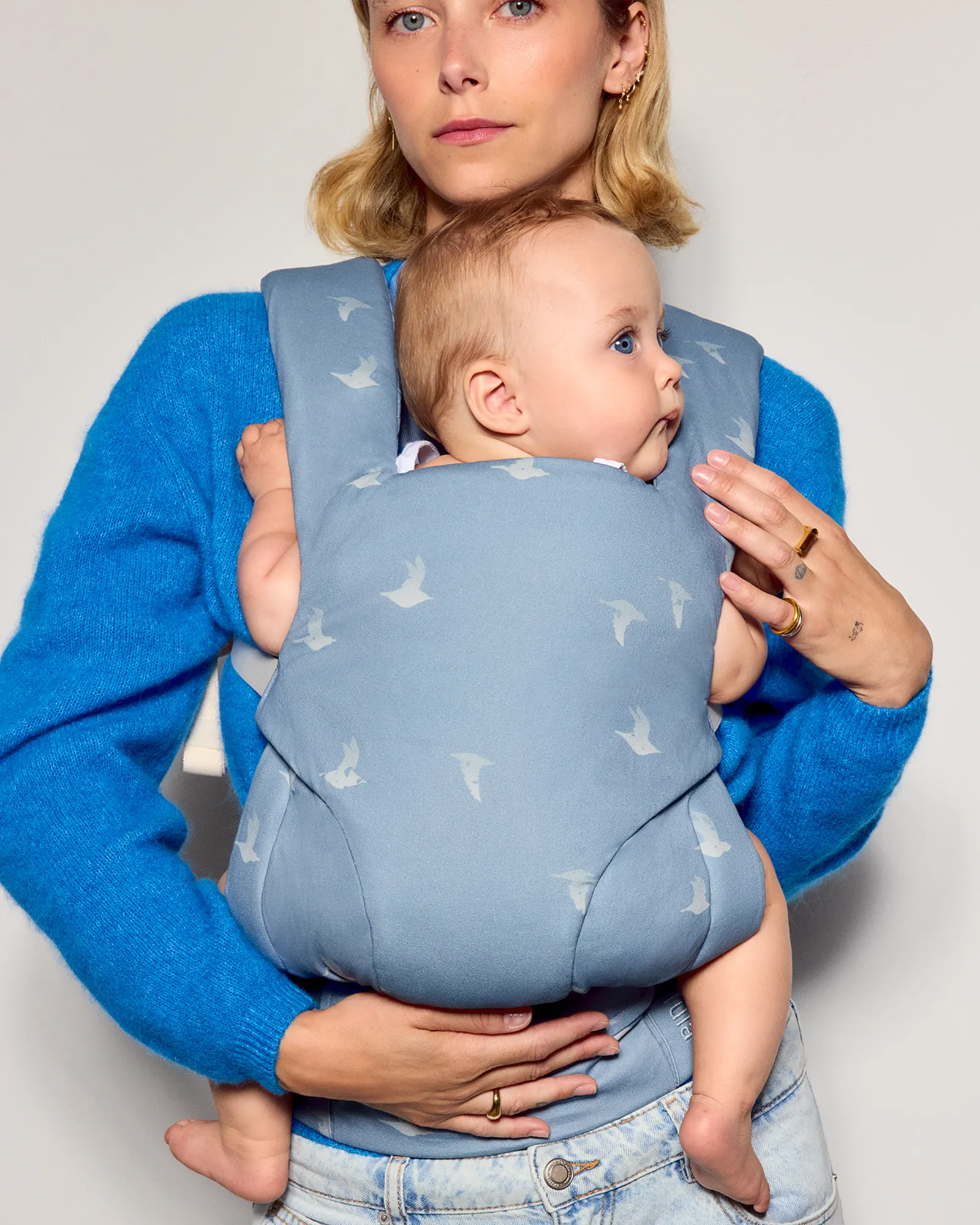
The front inward carry in a Tula
The front inward carry, the one you will use most. Photo: Tula

Then check the fit, every single time

The quick version is TICKS, the UK babywearing safety guidance:

  • Tight, so they are held against you rather than slumping
  • In view at all times, with nothing covering their face
  • Close enough to kiss, their head just below your chin
  • Keep their chin off their chest, with a finger’s width of space under it
  • Supported back, in a natural curve rather than folded forward

If you can comfortably rest your chin on their head, you have the height right. If you have to lean forward to see them, the carrier is too loose.

Facing out: when, and for how long

Facing out is the position everyone wants to try, and the one with the most rules attached.

Wait until your baby has strong, steady head and neck control and can hold their head up unaided, which for most babies is somewhere around five or six months. Before that, the inward carry is the only safe option.

Keep outward facing sessions short. Twenty to thirty minutes is plenty, and turn them back in the moment they look tired, glazed, or start arching away. Facing out is a lot of world at once, and there is no shoulder to hide in. It is also not a position for sleeping: the second their head droops, turn them around.

On a Tula Explore, the outward position uses the narrowest seat setting with the panel folded down so their arms are free. This short official Tula video walks through it.

The back carry, and when to move to it

Back carrying comes later, usually once your baby can sit unaided and you have both been happy with the front carry for a while. It is the position that makes a toddler bearable on a long walk, because the weight sits where a rucksack would.

Do the first few over a bed or a sofa, or with another adult to spot you, until the hand movements feel automatic. Once it clicks it takes seconds, and it is what gets you round a Christmas market with a three year old who has decided their legs no longer work.

The Tula Explore and the Tula Kid both do a back carry.

Five things that usually fix an unhappy carry

They keep slumping down. Straps are too loose. Tighten the shoulders first, then the waistband.

Your shoulders ache after ten minutes. The weight is sitting too high on your back. Drop the chest clip slightly and tighten the waistband so your hips take more of it.

Their legs look straight rather than M shaped. The seat is too narrow for their size. Widen it a setting and reseat them by supporting their bottom and giving a gentle bounce.

They scream the moment they go in. Try when they are fed and calm rather than at the point of meltdown, and move while they settle. Almost nobody loves a carrier while standing still.

It feels like a two-person job. It will for the first week. Practise with a teddy on the kitchen floor. It genuinely helps.

Which Tula you are putting on

Tula Explore, £199.90. Three carry positions, inward, outward and back, from 3.2kg to 20.4kg, roughly birth to four years. Padded shoulder straps, an adjustable waistband and a storage pocket.

Tula Original, £164.90. The simpler everyday fit, over the same 3.2kg to 20.4kg range.

Tula Kid, £164.90. From 11.3kg to 27.2kg, around two to six years, with a head support pillow, a sun hood and a supportive waist belt.

All three sit on the ergonomic design Tula has refined since 2009, and Tula is a business member of the Baby Carrier Industry Alliance.

If in doubt, get a second pair of eyes

A fit that looks right in the mirror can still be wrong, and nobody can see their own back. Your health visitor will check it, and most areas have a sling library where someone will adjust it for you for free and let you practise. Ten minutes there saves weeks of guessing.

Tula Explore £199.90 · Tula Original £164.90 · Tula Kid £164.90

Shop the Tula collection

Frequently asked questions

When can my baby face forwards in a Tula?

Once they have strong, steady head and neck control and can hold their head up unaided, usually around five to six months. Keep sessions to twenty or thirty minutes and turn them back in if they get tired or overstimulated.

Do I need a newborn insert for a Tula?

No. The Tula Explore and Tula Original carry from 3.2kg with no separate insert. You set the seat to its narrowest setting instead.

How do I know the seat width is right?

The seat should reach from the back of one knee to the back of the other, with their knees higher than their bottom. If the fabric stops at mid-thigh it is too narrow, and if it pushes past the knee it is too wide.

How long can my baby stay in a carrier?

There is no fixed limit for a well-fitting carrier and a happy baby, but check on them often, take them out for feeds and nappy changes, and give them time out of it across the day. Never let a young baby sleep with their chin on their chest.

When can I start back carrying?

Usually once they can sit unaided and you are both confident with the front carry. Practise the first few over a bed, or with someone else there.

AD: this article is a paid partnership with Tula. Product details and prices come from Tula and were correct at the time of writing. Always follow the manufacturer’s instructions and the Lullaby Trust’s TICKS guidance. If you are unsure about fit, check with your health visitor or a local sling library.

If you’re trying to conceive (TTC), you probably know that there are certain foods and nutrients that become especially important once you’re pregnant. But nutrition plays a vital role even when trying to conceive, much like laying a strong foundation before constructing a house.

Certain nutrients create that foundation by supporting egg and sperm health (yes, nutrition matters for both partners), hormone balance and creating a hospitable environment for a fertilized egg to implant. In fact, studies show that certain nutrients can help increase fertility and improve success rates for both natural conception and fertility treatments.

‍

In other words, nutrition is a key player in the TTC journey, but getting the right nutrients in the right quantities can be tricky. That’s where supplements come in. Just as you’d take a multivitamin to fill in nutritional gaps for optimal health, fertility supplements can give you that extra nutrient boost.

‍

Choosing supplements for your fertility journey

‍

When choosing a supplement to support your fertility journey, look for science-backed, high-quality ingredients. Our editors are careful to select and partner with brands that use ingredients that have been clinically studied to support fertility. Eu Natural® (pronounced you) covers all those bases and more. We love knowing that Eu Natural® products contain zero artificial additives, binders, or fillers and are lab-tested to ensure purity and potency.

‍

Photobook: Luthier. Beeches Lane by &Something

When choosing a supplement to support your fertility journey, look for science-backed, high-quality ingredients. Our editors are careful to select and partner with brands that use ingredients that have been clinically studied to support fertility. Eu Natural® (pronounced you) covers all those bases and more. We love knowing that Eu Natural® products contain zero artificial additives, binders, or fillers and are lab-tested to ensure purity and potency.

Tula logo
Tula
Tula is an award-winning babywearing brand.

An award-winning industry leader since 2009, Tula creates thoughtfully designed, ergonomic baby carriers that support the bond between caregiver and child from birth through 4 years old and beyond. Tula Baby Carriers feature thoughtfully curated colours, fabrics, and prints that blend fashion-inspired design with everyday functionality. Tula is proud to meet and exceed safety standards and norms and is a business member of the Baby Carrier Industry Alliance (BCIA).

https://babytula.com/en-gb